
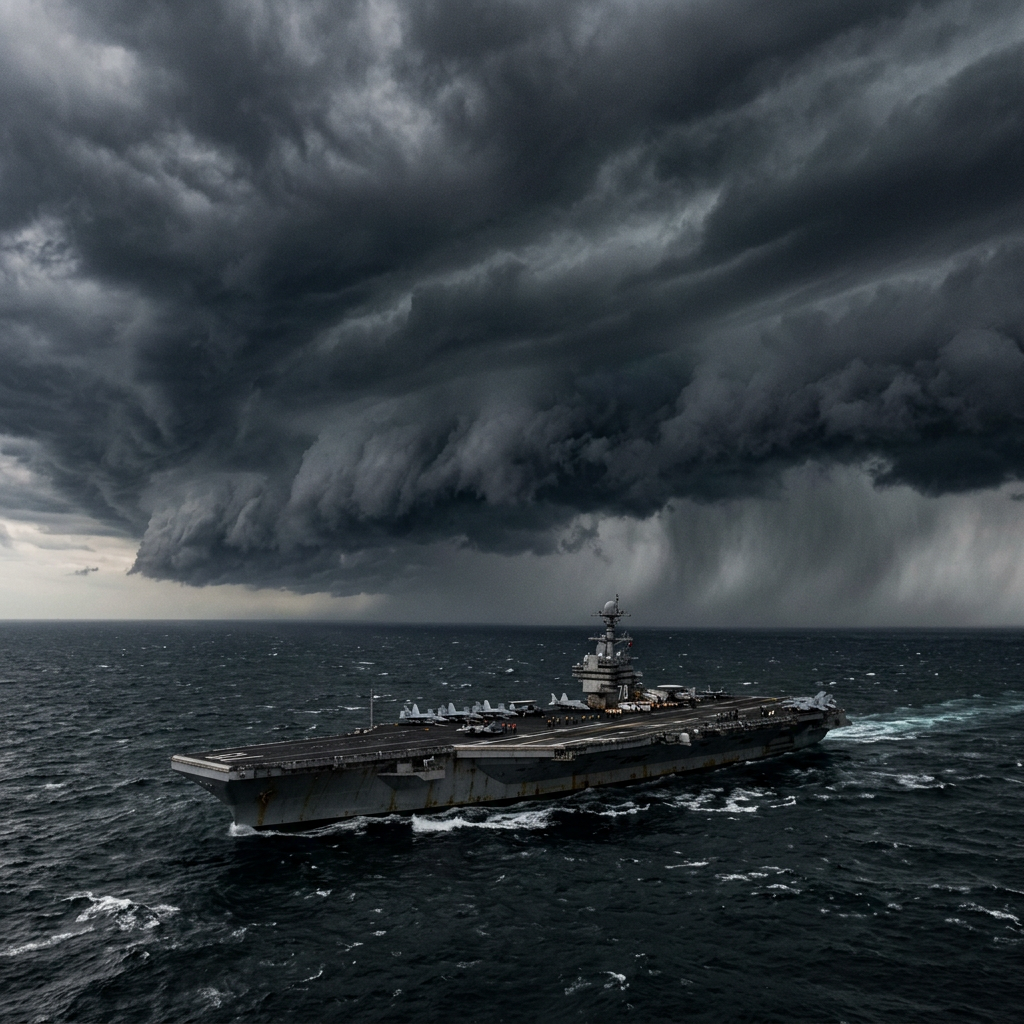

A sailor on the USS Abraham Lincoln saw a shipmate moving toward the side of the ship. He called out. He closed the distance, got hold of the man’s arms, and pulled him back onto the deck. Three other sailors reached them after it was over. He told his wife, Maria Rodriguez, about it days later. “He said he hadn’t felt adrenaline like that in his life,” Rodriguez said, “and he was just so thankful he was able to get to him in time.”
That is the United States Navy in August 2026. Sailors saving each other from a deployment their own leadership will not end.
The Lincoln has been at sea long enough to break its own crew. That is proof this administration has failed a basic duty: protect the people it sends to carry out its orders.
No veteran needs a briefing on the bond between those who served before and those serving now. We know the creed. No one gets left behind. Not on the ground. Not at sea. Not in a bunk beneath a flight deck while leaders in Washington stretch a deployment past its limits and call it strength.
I spent 23 years in the Air Force and retired a senior master sergeant, which put me on the enlisted side of an extension every time, never the side that signs one. An extension does not hit a unit all at once. It lands on the people who have to keep the schedule running after the news, and they absorb it, and the work still gets done, so nobody above them ever sees the bill. That is the trap. A crew coming apart still launches aircraft. Right up until it doesn’t.
The Lincoln left San Diego on November 21, 2025. It was scheduled for a seven-month deployment. As of August 12, it had passed 250 days deployed, more than 200 of them without a single port call. That is a modern-carrier record. There is no return date on the books.
This is not readiness. This is neglect with a flag on it.
A crew is sounding the alarm
The ship’s sailors and Marines operate in a harsh and dangerous place. They work around jets, fuel, weapons, heavy gear, heat, noise, and combat risk. Commanders do not get to demand perfect performance while denying crews the basic support needed to stay safe.
Families describe a half-cup of rice and two tortillas for a meal. A ship’s store out of soap, deodorant, and toothpaste. Mold in the showers. Toilets that do not flush. A laundry system that quit, which means a sailor works his shift around jet fuel and hot steel and then puts the same uniform back on. Two hundred days of that, inside a steel hull, with the plumbing backed up and nothing left on the shelf to wash with. Everybody aboard has been smelling it since spring. Bonnie York, whose stepson serves aboard the Lincoln, put it plainly: “The morale is not good. Apparently, the ship’s doctor or therapist said they need to hit port soon or people are going to start, you know, losing their minds.”
Annabelle Loma’s husband tried to go overboard. He is on medical hold now. “He’s scared. He thinks he’ll get a dishonorable discharge, and just because he was burnt out, his 13-year career is ruined, just like that,” Loma said. “That’s not fair, that’s not right. That’s not what he should be worrying about right now.”
The man Maria Rodriguez’s husband pulled off the rail was not the only one. One producer tracking the deployment put the number of overboard attempts at six. The Navy will not confirm a count.
One spouse got a message from her husband the same day she spoke to a reporter: “he hopes he doesn’t wake up tomorrow.” A sailor told a reporter, “There’s nothing to really look forward to at this point.” Crew members say they would skip the next port call entirely if it meant getting home sooner.
That is a ship running out of hope.
Washington talked. The sailors are still waiting.
More than 200 family members packed a room in San Diego to confront acting Navy Secretary Hung Cao. They came with one question. When is the ship coming home.
Cao told them the Navy is preparing USS Theodore Roosevelt to eventually relieve the Lincoln. He would not say when. Vice Adm. Joseph Cahill, who leads Naval Surface Forces, told the room: “We hear you loud and clear regarding the impact this has on families, on service members and the long-term ability of us to stand, sustain our forces’ health.” A second, virtual session followed that same evening.
One spouse in the room said what the town hall had actually produced: “broken trust between us and the leadership.”
The Navy’s official line has not caught up to what families are hearing from the ship. Officials say they have “not identified” any increase in suicidal ideation or attempts aboard the Lincoln. That claim has to sit next to two named overboard incidents, an unconfirmed count as high as six, and a spouse holding a text message that says her husband hopes not to wake up. The Navy also disputes the specifics on food and water, saying sailors have “continuous access to clean water, functional AC, and healthy meal options.” Back in April, when the first reports of food shortages surfaced, the Secretary of Defense called them “fake news” and the Navy released photos of full trays.
Photos of a tray prove nothing about the hundredth day at sea. They prove even less about the two-hundredth.
Families have been told they will get a 58-day window to relocate once the ship comes home. Navy leadership treats December 31 as a target for setting a timeline, not a homecoming date.
A carrier is a combat system. Sailors are the part of that system no supply order can replace. Run them into the deck and the system fails. Fatigue brings bad calls. Bad calls bring injuries, fires, aircraft losses, and death.
Washington knows this.
Cao says the Theodore Roosevelt will eventually relieve the Lincoln. Understand what that sentence costs. A carrier does not come home and reset. It comes home worn, the maintenance bill comes due, and the crew that just stood 250 days is the same crew that has to train up for the next one. Every extension is a loan. The Navy is borrowing readiness from the Roosevelt‘s sailors to cover a bill it ran up on the Lincoln‘s. Nobody in Washington has said who pays it back.
The politics end here
The administration loves the image of military power. It sends carriers to project force. It uses sailors as proof of resolve. Resolve without care is abuse of authority.
The Lincoln was moved from the Pacific toward the Middle East as tensions with Iran rose, and it has now logged 40 straight days of combat operations tied to that war on top of everything else. Its presence gave the White House more military options. Those options came with a human cost carried by roughly 5,000 sailors and Marines, plus their families.
A president does not earn respect by keeping a carrier at sea until the crew breaks. A defense secretary does not defend the country by calling hungry sailors’ families liars. Senior leaders do not honor the oath by treating supplies, rest, safety, and mental health as public-relations problems to be managed with a photo op.
This also exposes a deeper failure. The military is supposed to stand above partisan loyalty, racial bias, and gender bias. Its oath binds service members to the Constitution, not to the ego or political needs of any administration. Allegations of discrimination require a real investigation, with records, witnesses, and a written conclusion. The Lincoln record already shows a separate and undeniable failure: leaders placed mission tempo above the well-being of the force that makes the mission possible.
That violates the spirit of “no one left behind.”
A sailor does not have to be abandoned in a desert to be left behind. A sailor can be left behind by an inbox in the Pentagon. By a broken supply chain. By an endless extension. By an order that has no clear end state. By a Navy statement that says “not identified” when a wife is holding the text message that says otherwise.
The remedy
Sen. Richard Blumenthal has already started asking the right questions. In an August 12 letter to the Defense Secretary and the Acting Navy Secretary, copied to the Chief of Naval Operations, Blumenthal demanded a straight answer on the Navy’s plan for carrier presence in the Middle East over the next 12 to 24 months. He asked for a full account of every extension and who authorized it. He asked about the mold, the broken toilets, the water shortages, and the missing hygiene products. He asked for a clear statement of the military objective tied to Iran. “The Lincoln is not an isolated case,” Blumenthal said. “The Department owes them not only adequate supplies, maintenance, and support during this deployment, but a sustainable force-generation model that does not rely on repeatedly extending sailors and ships to meet persistent operational demands.” He gave the Pentagon until August 27 to respond.
That deadline is not enough on its own. Congress must act now, not after an avoidable tragedy forces its hand. These are the demands.
- Order an independent inspection of habitability, food, water, medical access, mail, maintenance, and safety conditions aboard the Lincoln, conducted by inspectors with no chain-of-command reason to call it fine.
- Require the Navy to name a firm relief date for the Theodore Roosevelt handover and hold leadership to it publicly, not just in a closed-door town hall.
- Establish a hard limit on consecutive days at sea without a port call, except during a declared emergency approved by Congress.
- Direct an independent, anonymous survey of the crew on fatigue, morale, sleep, mental health, safety incidents, and access to care. Protect every sailor who answers honestly from retaliation or discharge threats.
- Send resupply, repair teams, additional mental-health staff, and relief personnel to the strike group this week, not after the next town hall.
- Require the administration to state the military objective in Iran, the legal basis for continued operations, the cost, the exit standard, and the plan to rotate forces without breaking crews.
- Hold public hearings with the Secretary of Defense, the Acting Secretary of the Navy, fleet commanders, enlisted sailors, spouses, and independent inspectors, on the record, not behind a closed door in San Diego.
The sailors on the Abraham Lincoln have done their part. They showed up. They stood the watch. They pulled their own shipmates back from the rail with their bare hands. They carried a war shaped by political choices far above their pay grade.
Now the country must do its part.
Bring accountability to the chain of command. Restore the crew’s basic living conditions. End the blank-check deployment model. Give the sailors a firm date, a real rotation plan, and a path home.
Anything less is not support for the troops. It is betrayal.