
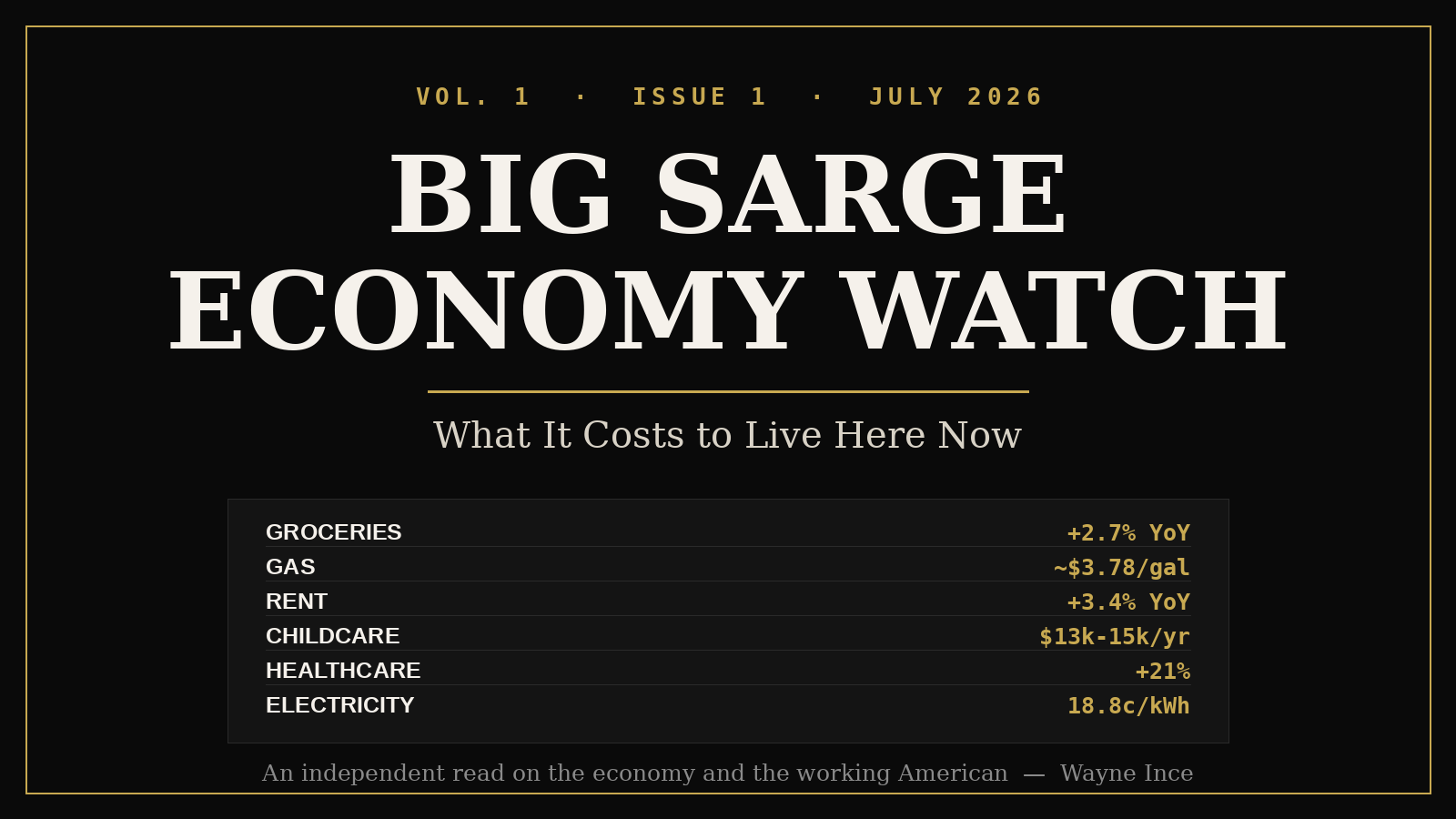
Vol. 1 · Issue 1 · July 11, 2026 Welcome to the first edition of Economy watch.

Editor’s Note
The economy on paper and the economy in your kitchen are two different animals. One shows up in a quarterly report. The other shows up when you swipe your card at the pump, open the daycare invoice, or read the letter from your insurer.
This edition tracks the second economy — the one wage earners actually live in. Prices climbed 4.2% over the year in the latest CPI reading, the hottest since April 2023, while paychecks slipped behind inflation for a third straight month. That gap is not a rounding error. It is rent money. It is a tank of gas. It is the difference between a family holding the line and falling behind.
Six fronts. Real numbers. No spin. Let’s walk the receipts.
In This Issue
- The Grocery Aisle Doesn’t Forgive — Food at home, +2.7% YoY
- At the Pump, a Fragile Truce — Gas, ~$3.78/gal, up ~21% YoY
- Rent Flattens on a High Plateau — Shelter CPI, +3.4% YoY
- Childcare: A Second Rent Nobody Voted For — $13,000–$15,000 per child, per year
- Healthcare’s Biggest Jump Since 2010 — ACA premiums, +21%
- The Power Bill Nobody Can Turn Off — Electricity, ~18.8¢/kWh, up ~5.4% YoY
01 · The Grocery Aisle Doesn’t Forgive
Food at home · +2.7% year over year
Grocery inflation cooled to about 2.7% over the year, and on paper that reads like relief. Stand in the checkout line and it reads like a memory of cheaper times that isn’t coming back. The slowdown is in the rate of increase — not the price. Meat hit a fresh record on the global index, vegetable oils ran more than 23% above a year ago, and the cart that fed a family for a hundred dollars three years ago now needs a bigger bill.
Key takeaway: A slower climb is not a discount. Families are paying today’s prices on paychecks that haven’t caught up.
Source: FAO Food Price Index & BLS CPI, June 2026
02 · At the Pump, a Fragile Truce
National average · ~$3.78/gal, still up ~21% YoY
Gas backed off its June spike, sliding to roughly $3.78 a gallon after weeks of decline tied to easing Middle East tensions and the reopening of the Strait of Hormuz. Good news, until you check the calendar. Prices are still running about 21% higher than a year ago, and analysts warn the relief could reverse fast if oil ticks back up. For the commuter who drives to earn, every nickel at the pump is a nickel that never reaches the grocery aisle or the rent envelope.
Key takeaway: The dip is welcome and unreliable. Budget for the year-ago comparison, not the good week.
Source: AAA & EIA weekly fuel data, July 2026
03 · Rent Flattens on a High Plateau
Shelter CPI · +3.4% YoY, the stickiest line in inflation
Market rents have finally clawed back to roughly flat — the national average one-bedroom sits near $1,645, up just 0.4% over the year. But the shelter component of CPI still rose 3.4%, the stickiest piece of inflation there is, because leases lag the market. Renters aren’t feeling a rollback. They’re feeling the ceiling that got built during the surge and never came down. Flat, at this altitude, still means half a paycheck gone before the first grocery run.
Key takeaway: Stable rent is not affordable rent. The plateau was set at the peak, and wages never reached it.
Source: Zumper & Apartments.com Rent Reports, June 2026
04 · Childcare: A Second Rent Nobody Voted For
National average · $13,000–$15,000 per child, per year
Full-time center-based care now runs $13,000 to $15,000 a year for a single child, with infant care in many metros pushing well past that. Costs have climbed roughly 23% in five years, faster than inflation in 39 states, and exceed the average rent in all 50. The federal government calls childcare “affordable” at 7% of household income. The typical family is spending closer to 24%. In 38 states, a year of infant care costs more than in-state college tuition. This is not a line item. It is a second mortgage on the working years.
Key takeaway: For young families, childcare is often the single largest bill — bigger than rent, bigger than the car. It quietly decides who can afford to work at all.
Source: Child Care Aware of America & Care.com, 2026
05 · Healthcare’s Biggest Jump Since 2010
ACA premiums · +21% | subsidized net payments · +114%
The math on staying healthy got meaner. Average ACA marketplace premiums jumped about 21% for 2026 — the steepest single-year climb since 2010 — reaching roughly $752 a month before subsidies. Worse for the 22 million who relied on enhanced subsidies now expiring: net premiums more than doubled, up 114% on average from $888 to $1,904 a year. Employer plans offered no shelter either, with the average family PPO share climbing near $8,900. When the price of not getting sick rises this fast, coverage becomes a gamble ordinary families are forced to place.
Key takeaway: This is the quiet emergency. The subsidy cliff is turning insured families into underinsured ones overnight.
Source: KFF & CMS marketplace data, 2026
06 · The Power Bill Nobody Can Turn Off
Residential electricity · ~18.8¢/kWh, up ~5.4% YoY
The one bill you can’t skip is climbing faster than your paycheck. Residential electricity hit about 18.8 cents a kilowatt-hour, up roughly 5.4% over the year and around 21% higher than five years ago — rising faster than inflation for the first time since before the pandemic. The average household electric bill now runs $136 to $165 a month, and forecasters expect summer 2026 cooling bills to land about 8.5% above last summer. Part of the squeeze isn’t even coming from your house: surging demand from data centers is helping push rates up, and families are footing the difference on the East Coast especially. You can’t conserve your way out of a rate hike.
Key takeaway: Electricity is the bill with no substitute. When rates rise, low- and fixed-income households feel it first and hardest — and the heat wave doesn’t care about your budget.
Source: EIA Electric Power Monthly & NEADA summer outlook, 2026
The Bottom Line
Add it up and a pattern shows: prices that plateau at painful highs, a pump truce that could break, two bills — childcare and healthcare — swallowing whole paychecks, a power bill with no off switch, and real wages that have trailed inflation three months running. The recovery is real for the balance sheet. For the wage earner, it still reads as a squeeze. The task now is to name it plainly and refuse to let “cooling inflation” become a story we tell to avoid looking at the receipts.
An independent read on the national economy and the working American. Founded and written by Wayne Ince. Brandon, Florida.
Leave a Reply